

Why C3
Why Compassion
At the Center for Compassionate Connections we believe that communicating from a place of genuine concern, care, and mutual respect enriches our relationships and helps us create strong communities, making our world a better place in the process. We are dedicated to serving everyone and anyone who is interested in learning new ways to elevate their lives and the lives of those with whom they live and work through compassionate interaction.
Compassion is the beautiful and compelling life force within each of us that stirs us to service. It emerges in the face of injustice and suffering, and inspires us to respond with love. It grows naturally from our recognition that we are connected to everyone and everything on the planet.
Our Vision
The Center for Compassionate Connections (C3) is dedicated to advancing compassionate thought, communication and action within all communities - home, school and work.
Our Mission
C3’s mission is to provide children, families, schools and other community organizations with resources that empower them to create the compassionate, fulfilling and happy relationships and lives they desire.
- Utilizing an adaptable and replicable framework, we provide training and tools for developing compassion for self and others.
- Compassion is a fundamental human quality that we cultivate through C3’s evidence-based communication and curricular resources designed to develop skill sets, heighten self-awareness, and strengthen human connection.
- By gaining a personal understanding of the power we possess to transform our emotions, perceptions and behaviors through compassion, we can shift the culture of our homes, our schools and our communities so that we experience more happiness, success and well-being in our lives.
Our Model
At the heart of what we try to accomplish while working with people of all ages and in all communities is building compassionate connection. Our theory of change model for creating compassionate communities includes 5 important contributors: 1) Inclusion, Safety and Trust (creating an environment in which each person is given unconditional messages of their value—that they are perfect, whole, and capable just as they are); 2) Authenticity, Uniqueness, and Integrity (encouraging each person’s unique voice and gifts to emerge in ways that enrich the whole and what can be accomplished within it); 3) Understanding, Connection and Unity (building mutual understanding and appreciation of our interrelatedness and connection, and our collective responsibility to individual and shared success); 4) Purpose, Service and Global Citizenship (empowering the members of the community to recognize and give full voice to their natural impulse to enrich life, to recognize the connection they have with one another, and to make a purposeful difference in the world, both individually and collectively); 5) Happiness, Gratitude, and Celebration (acknowledging and celebrating the joy that accompanies truly experiencing the magnificence of our humanness; understanding and appreciating what we can accomplish together; and living a life in which service is an essential ingredient). To us, compassion is the source from which love springs. It is the beautiful and compelling life force within each of us that stirs us to service. It emerges in the face of injustice and suffering, and inspires us to respond with love. It grows naturally from our recognition that we are connected to everyone and everything on the planet.

Our Model for Schools
Our Five Guiding Principles for Academic and Personal Excellence at School
Compassion and Relationships
The heart of this school model rests in building an inclusive community in which caring relationships are formed, and a sense of safety and trust are consciously developed, knowing that students are more likely to take the kinds of risks necessary for deep and sustained learning when they feel safe doing so. Teaching a language of compassion, demystifying differences and challenges, teaching the multiple intelligences, brain science, and social emotional learning skills, ensures that students ultimately see themselves as learners and thus capable of excellence. When children feel safe they act on their natural desire to explore, to learn, to contribute to the wellbeing of others, to become leaders, and to excel.
Collaboration and Shared Leadership
Our model values collaboration between all members of the community—children and adults—believing in the power of choice and shared leadership at all levels. Students who are trusted and taught to assume leadership roles, who feel safe, and who learn and practice the skills needed to understand and manage themselves and their relationships with others, reveal their uniqueness with integrity and bring their authentic voices into their school lives, thus strengthening the whole community and what can be accomplished within it. Working in groups is basic to the development of these skills. Learning to regulate their emotions, while developing their resilience, flexibility and confidence, prepares students to collaborate and lead, two vital skills in our evolving and increasingly interdependent world.
Meaningful and Inclusive Curricula
It is important that the different school curricula have relevance for students and that they are differentiated, made accessible, and are assessed in a variety of ways in order that all students can successfully and joyfully participate in the learning process. Deep knowledge, skill, understanding, and ultimately, connection, and unity are accomplished through vigorous inquiry and project-based learning which includes multiple and varied experiences with traditional subject matter including the arts, and incorporates the exploration of issues grounded in social justice, environmental sustainability and ultimately personal fulfillment. When children’s learning is differentiated based on logical next steps and directly applies to and incorporates their cultural and personal experiences and interests, they are more likely to own the information, retain and expand on it, reapply it and teach it to others.
Service Learning and Global Citizenship
When students’ basic need for safety, love and support are met, they naturally look outside themselves, motivated by the wish to connect with and contribute to the wellbeing of others. We advocate creating opportunities for students to pursue purposeful pursuits with classmates in every moment, no matter the age, recognizing that contributing to the wellbeing of others is a powerful motivator and thus an important way to engage students in maximal learning. Emphasis is placed on service learning and the development of global understanding and citizenship. When children participate in global service projects and learn another language, it engages their authentic interest in other world cultures, develops a deepened understanding of different beliefs and values, and encourages their compassion for all human beings, as well as for the earth’s environments.
Health and Wellness
In a compassionate school culture we emphasize and support social, emotional and personal wellness as well as physical health and wellness. Students are regularly provided opportunities to deepen their knowledge of themselves and of their relationships with others. In an ongoing way, the school supports the whole child and the whole family, recognizing that student success is inextricably tied to the success of the family system. We promote student and adult happiness and gratitude through regularly scheduled rituals and celebrations. When healthy eating and exercise are a daily part of children’s lives, and when their personal and social wellness needs are met, their emotional and physical wellbeing are promoted, both now and into the future.

Results
• Heart Talk manuals and accompanying picture book for educators and families
• Compassionate Communication workshops for families and educators
• Family Community Resource Center serving students and families at Isabella Bird Community School in Denver Public Schools
• Social-Emotional Learning (SEL) Professional Learning workshops for Pre-K – 2 educators
• Compassion in the Classroom Social-Emotional Learning Curriculum for Pre-K and K students
Impact
3 continents
7 countries
31 nations
150 nationalities
1,350 parents
3,500 students
over 10,000,000 interactions
Research
text about research
This is where we would talk about learning science
Here would would talk about brain science
CASEL's (Collaborative for Academic, Social and Emotional Learning) Five Keys to Social and Emotional Learning
- Self-awareness: The ability to accurately recognize one’s emotions and thoughts and their influence on behavior. This includes accurately assessing one’s strengths and limitations and possessing a well-grounded sense of confidence and optimism.
- Self-management: The ability to regulate one’s emotions, thoughts, and behaviors effectively in different situations. This includes managing stress, controlling impulses, motivating oneself, and setting and working toward achieving personal and academic goals.
- Social awareness: The ability to take the perspective of and empathize with others from diverse backgrounds and cultures, to understand social and ethical norms for behavior, and to recognize family, school, and community resources and supports.
- Relationship skills: The ability to establish and maintain healthy and rewarding relationships with diverse individuals and groups. This includes communicating clearly, listening actively, cooperating, resisting inappropriate social pressure, negotiating conflict constructively, and seeking and offering help when needed.
- Responsible decision making: The ability to make constructive and respectful choices about personal behavior and social interactions based on consideration of ethical standards, safety concerns, social norms, the realistic evaluation of consequences of various actions, and the well-being of self and others.
SEL Impact – from CASEL (Collaborative for Academic, Social and Emotional Learning) – www.casel.org
An extensive body of rigorous research (including randomized control trials, longitudinal follow-ups, and multiple replications) demonstrates that education that promotes social and emotional learning (SEL) gets results, and that teachers in all academic areas can effectively teach SEL.
The findings come from multiple fields and sources that include student achievement, neuroscience, health, employment, psychology, classroom management, learning theory, economics, and the prevention of youth problem behaviors.
Key studies include:
SEL Impact on Academic Outcomes
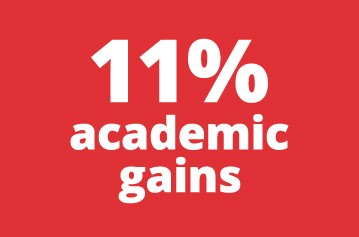
According to a meta-analysis of 213 studies involving more than 270,000 students, those who participated in evidence-based SEL programs showed an 11 percentile-point gain in academic achievement compared to students who did not participate in SEL programs. Compared to students who did not participate in SEL programs, students participating in SEL programs also showed improved classroom behavior, an increased ability to manage stress and depression, and better attitudes about themselves, others, and school.
SEL Impact on Equity and Poverty
According to a 2015 report by the American Enterprise Institute and the Brookings Institution, SEL competencies are critically important for the long-term success of all students in today’s economy. This report was developed by a group of bipartisan experts who agreed to set aside their differences and create a detailed plan for reducing poverty and increasing economic mobility.
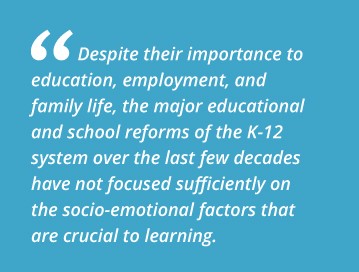
The authors noted that major educational and school reforms over the past few decades have not sufficiently focused on the SEL factors that are necessary to education, employment, and family life.
The report also recommends an effort to scale up high-quality, evidence-based SEL programs as a core component of education for children. It made three recommendations to the federal and state governments: (1) scale evidence-based SEL practices and policies; (2) implement high-quality state SEL standards, preschool through high school; and (3) establish SEL centers of excellence.
SEL Impact on Lifetime Outcomes
A 2015 national study published in the American Journal of Public Health found statistically significant associations between SEL skills in kindergarten and key outcomes for young adults years later in education, employment, criminal activity, substance use, and mental health.
The study concluded that early prosocial skills decreased the likelihood of living in or being on a waiting list for public housing, receiving public assistance, having any involvement with police before adulthood, and ever spending time in a detention facility.
SEL Benefit-Cost Analysis
A 2015 study by researchers at Columbia University found that the measurable benefits of SEL exceed the costs, often by considerable amounts.

The aggregate result of the analysis showed an average benefit-cost ratio of about 11 to 1 among the six evidence-based SEL interventions studied. This means that, on average, for every $1 invested in SEL programming, there is a return of $11.
Teachers Value SEL (from CASEL)
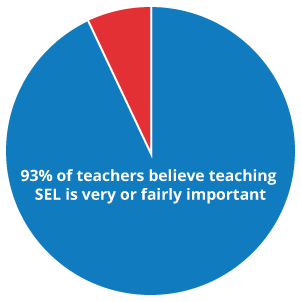
Teachers across America know that social and emotional learning is essential to student success in school, the workplace, and life. A survey of teachers commissioned by CASEL in 2013 found 93 percent of teachers want a greater focus on social and emotional learning in schools. These educators know that social and emotional skills are teachable and are calling for schools to prioritize integrating SEL learning practices and strategies into the curriculum as well as school culture.
Source: The Missing Piece
Employers Value SEL (from CASEL)
SEL provides students with many of the skills employers consider critical to success on the job. Beyond the skills unique to their specific field, employers also look for individuals who are good communicators, effective leaders, empathetic, goal-oriented, and persistent. According to a 2013 survey of 704 employers conducted by The Chronicle of Higher Education and American Public Media’s Marketplace, half of those surveyed said they had trouble finding recent graduates to fill vacancies in their companies. Even though applicants had the technical prowess, they lacked the communication, adaptability, decision-making, and problem-solving skills needed to do the job.
Businesses are beginning to realize the important role of social and emotional skills in the workplace and are creating reports that outline strategies for training employees and business students in effective and appropriate business communication.
In September 2016 CASEL and Committee for Children organized a Congressional briefing on the connection between SEL and employability skills. Click here to read the background and briefing papers.
Visit CASEL at www.casel.org
More SEL Impact and Outcomes
Inspiration
text about inspiration
